The campfire, iodine and seaweed character in some whisky has one main source, and it is a decision the distillery makes before anything is distilled.
What peat is
Peat is partly decayed plant matter that builds up in waterlogged bogs over thousands of years. Cut and dried, it burns slowly with thick smoke, and in much of Scotland it was the fuel at hand.
To make malt, barley is soaked, allowed to sprout, then dried in a kiln to stop it growing. Burn peat under that barley and the smoke clings to the grain. Its phenolic compounds survive mashing and fermentation and carry into the spirit.
So the smoke is in the barley. It does not come from the water or the cask. Most Scotch today is made from malt dried with hot air and no peat at all.
What the ppm number means
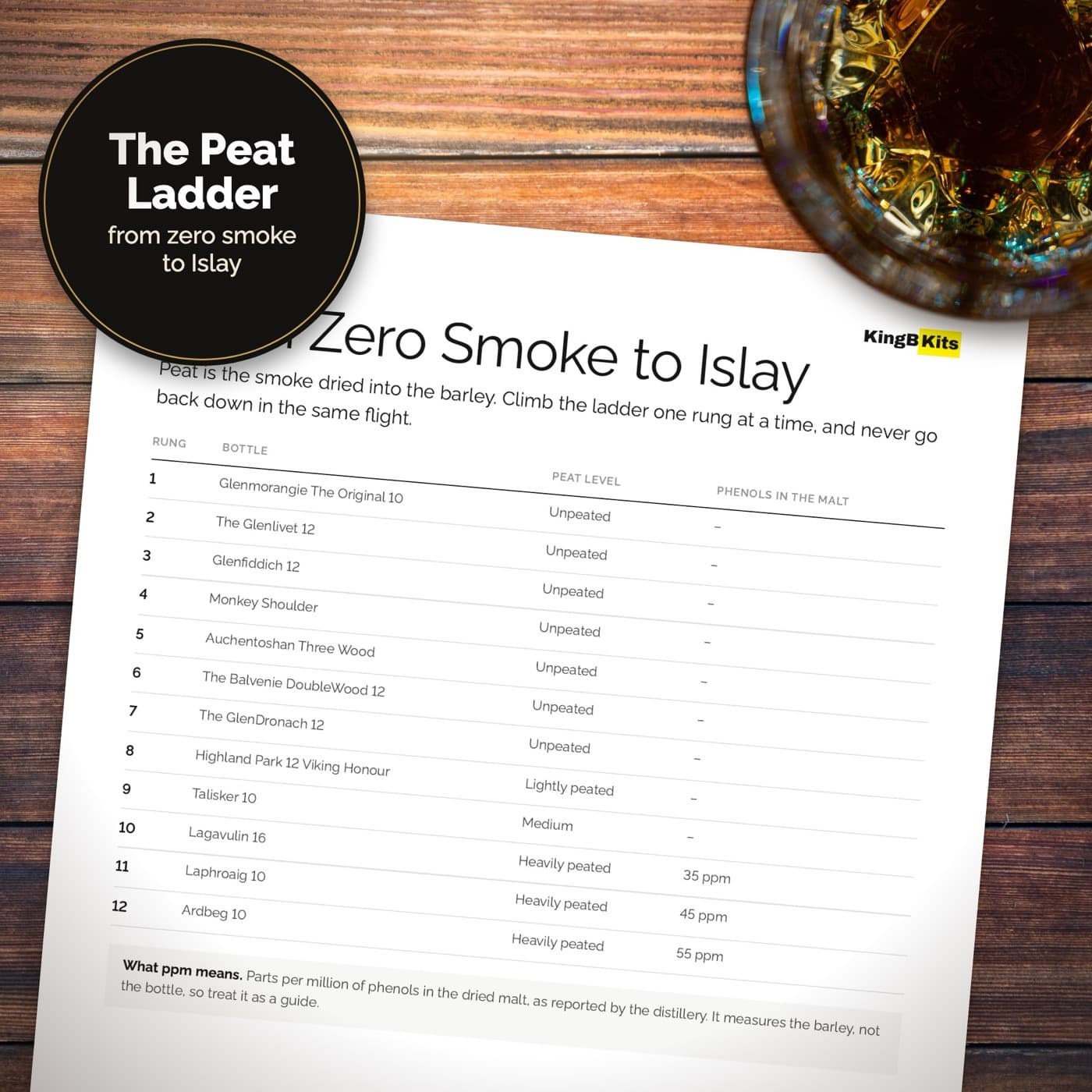
Distilleries that talk about smoke quote phenol levels in parts per million, or ppm. That figure measures the dried malt, not the whisky in your glass. Some of those phenols are lost in distillation and more fade during years in the cask, so ppm is a rough guide to intensity, not a reading of the bottle. Ardbeg, one of the smokiest everyday Islay malts, reports about 55 ppm for its malt.
Two whiskies with similar numbers can still taste different. Which part of the run the distiller keeps, the casks and the age all shape how the smoke comes across, and a young peated whisky usually tastes smokier than an older one from the same still. Where the peat was cut matters too: Highland Park uses Orkney peat, which gives a softer, more heathery smoke than the coastal Islay style.
Smoky is not always peated
Charred American oak gives bourbon toasty, sometimes smoky notes with no peat involved. And peat is not only campfire. It can read as tar, ash, bandages or seaweed, and "medicinal" is something Laphroaig fans say as a compliment.
Peat is not only an Islay thing either. Several Islay distilleries make unpeated whisky, Highland and Speyside distilleries release peated bottlings, and distilleries in Ireland and Japan make smoky whisky too. Scotch Regions, Explained covers why region is a first guess, not a rule.
How to pour it at a tasting
Peat lingers. One heavily peated glass early in a flight will flatten everything after it, so pour unpeated first and the smokiest last. If a guest finds an Islay malt harsh, a few drops of water often soften it; Should You Add Water to Whisky? explains why.
Expect the smoky glass to split the table. That is what makes it worth pouring.
The Peat Ladder in our Scotch 101 kit lays this out as a flight: twelve real Scotches climbing from unpeated to big Islay smoke, phenol figures where the distilleries publish them, and a blind Region and Peat Challenge to finish.