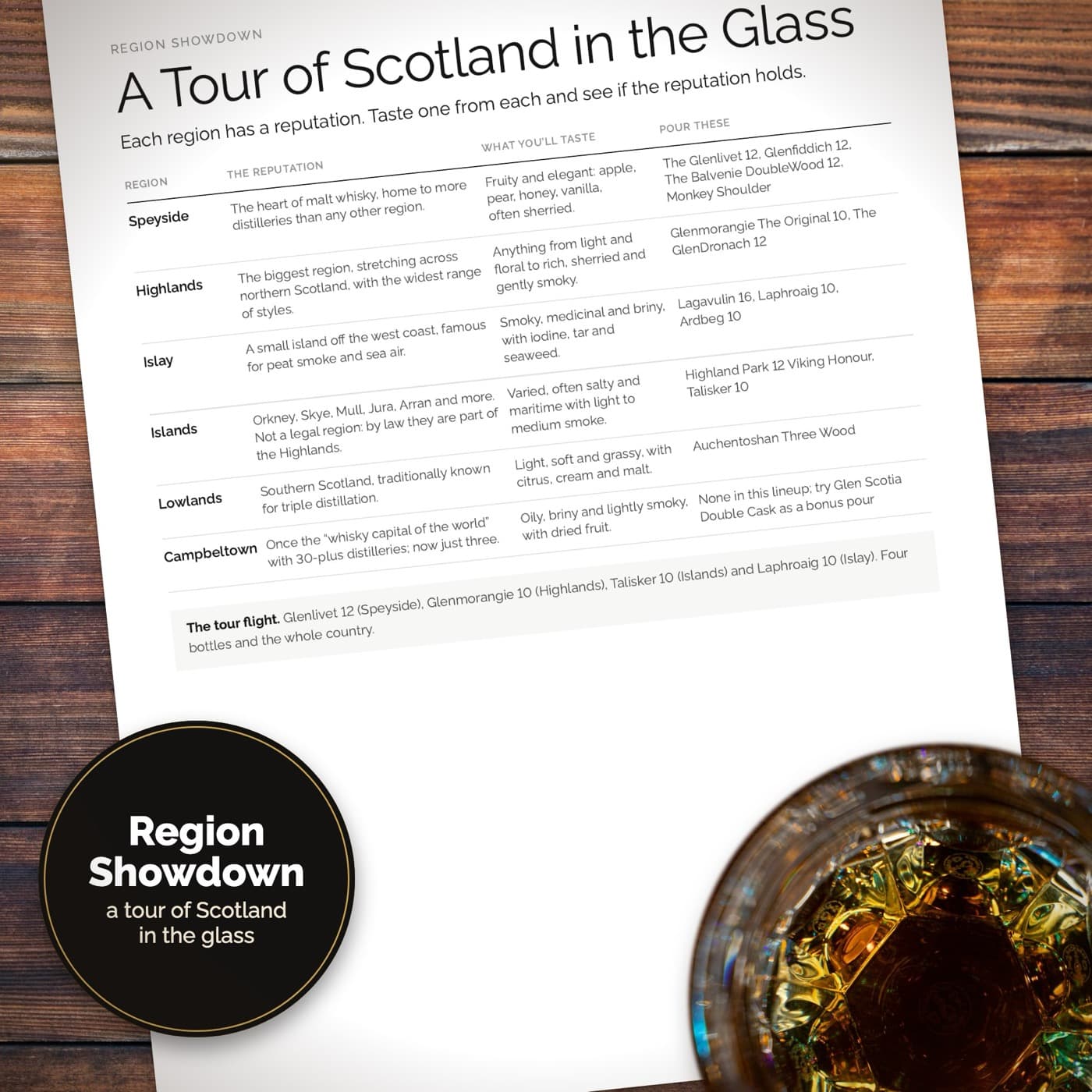
Scotch labels love to name a region, and shoppers treat that name like a flavor promise. It is closer to a weather forecast: a good starting guess, frequently wrong in the details.
The five legal regions
The Scotch Whisky Regulations recognize five protected regional names: Highland, Lowland, Speyside, Islay and Campbeltown. A distillery can put one on the label only if it actually sits there. "Islands" is not one of them. It is a popular grouping for Skye, Orkney, Jura, Arran and Mull, but legally those distilleries are Highland.
What each one usually means
Speyside has more distilleries than any other region, packed along the River Spey. The house style leans fruity, honeyed and gentle, often shaped by sherry casks. This is where most people's first single malt comes from.
Highland is the biggest region by far, which makes it the least predictable. It covers delicate floral whiskies, rich sherried ones, waxy coastal ones and a few smoky ones. "Highland" on a label tells you geography and very little else.
Islay is the smoke region. Its famous south-shore distilleries peat their malt heavily, and the medicinal, campfire, seaweed character people associate with Scotch mostly comes from here. But Islay is not all smoke: Bunnahabhain and Bruichladdich build their core ranges on unpeated spirit.
Lowland lost most of its old distilleries in the twentieth century and is rebuilding with new ones. The style reputation is the lightest in Scotland: grassy, citrusy, soft. Triple distillation, once a regional habit, survives at Auchentoshan.
Campbeltown was once packed with dozens of distilleries and is now down to a handful. Springbank is the reference point: oily, briny, a little smoky, and stubbornly old-fashioned in how it is made.
Where the map stops working
Region is a habit, not a rule. Peat is a decision the distiller makes about the malt, not something the local water hands out, so smoky Speyside and smoky Highland whiskies exist, and so do unpeated Islays. Cask choice matters even more: a sherry-cask Highland and a bourbon-cask Speyside can swap places in a blind tasting with ease. And most Scotch sold is blended, drawn from several regions at once, so the regional question only really applies to single malts.
How to use regions at a tasting
Treat region as the first guess, not the answer. Pour one Speyside, one Highland, one Island and one Islay, ideally climbing from unpeated to smoky so the peat does not flatten everything after it. Ask guests to name the region before the reveal. The misses are the lesson: they show exactly how much the cask and the peat decide.
Our Scotch 101 kit is built on that flight. Its Region Showdown and Peat Ladder pages walk the table from gentle to smoky, with real bottles sorted into three budget tiers.