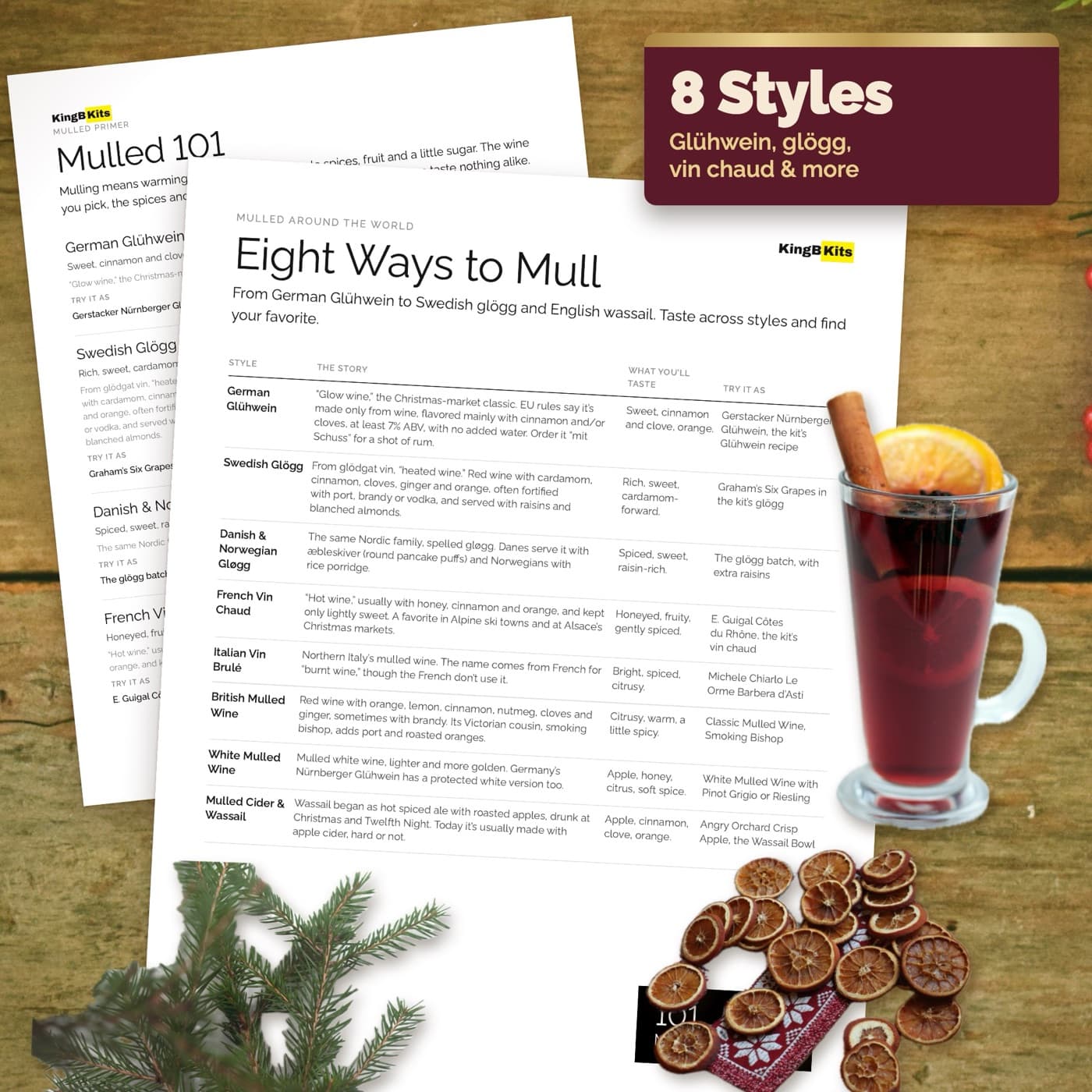
Every cold country has its own pot of hot, spiced, sweetened drink, and the names get used as if they were interchangeable. They aren't. The base, the spice, the strength and what ends up in the cup all change from place to place, and those differences are exactly what make a side-by-side pour worth doing.
Glühwein: the Christmas-market baseline
German and Austrian Glühwein ("glow wine") is the one most people picture: red wine, sugar, cinnamon, cloves and orange, ladled into a ceramic mug at a Christmas market. EU rules define it tightly. It has to be made only from wine, flavored mainly with cinnamon and cloves, with no added water and at least 7% ABV. White Glühwein exists too. Ask for it "mit Schuss" and you get a shot of rum or another spirit added to the mug.
Glögg: stronger, richer, and you eat it with a spoon
Swedish glögg (gløgg in Denmark and Norway) pushes cardamom forward alongside cinnamon, cloves, ginger and orange peel, and is often fortified with port, brandy, vodka or aquavit. The giveaway is the cup: a few raisins and blanched almonds go in the bottom, so it is served small with a spoon. It is a December staple across the Nordic countries, and bottled versions, including alcohol-free ones, are easy to find in the US around the holidays.
Vin chaud and its neighbors
French vin chaud ("hot wine") is usually the gentlest of the group: honey, cinnamon and orange, only lightly sweet. It is the house drink of Alsace's Christmas markets and Alpine ski towns. Northern Italy's vin brulé is a close relative, usually brighter with citrus. If someone at your party says these all taste like Glühwein, they are mostly right. The differences are in sweetness and spice level, not the idea.
Wassail: the one that isn't wine
Wassail is English, and it started as hot spiced ale with roasted apples, drunk at Christmas and on Twelfth Night. The word comes from an old toast meaning "be in good health." In cider country, wassailing also means a Twelfth Night orchard ritual of toasting the apple trees for a good harvest. Most American wassail today is hot apple cider with spices and orange, sometimes spiked with hard cider or brandy, which makes it the easiest of the four to serve to kids and non-drinkers.
Pour three side by side
The cleanest comparison is three small pots: a classic Glühwein, a glögg with its raisins and almonds, and a cider wassail. Keep each one steaming, never boiling, and serve 3 ounce pours so guests can finish all three. Our mulled wine party guide covers how much wine to buy and how to keep a pot at temperature.
The Mulled 101 kit lays out eight styles on one page, with recipes for the Glühwein, a glögg batch, a wassail bowl and an alcohol-free Kinderpunsch, plus a blind Mull-Off to settle which one your guests actually prefer.